Every karaoke host has a dirty secret. It's not the fog machine. It's the folder full of songs they've been meaning to organize since 2016.
You know the one. Twenty thousand files. Frank Sinatra - My Way.mp3 next to frank_sinatra_my_way_(1).zip next to SINATRA, FRANK - MYWAY.MP3 next to a file literally named Track01. Six different brands pressing the same song. A corrupted ZIP that's been sitting there since the Obama administration, waiting to ambush you the exact moment a bride requests it.
You don't fix it because fixing it means deleting things, and deleting things is how a working library becomes a broken one. So you don't touch it. You just… scroll faster.
Auto-KJ's Library Management tab is built for exactly this person — because it was built by exactly this person. It doesn't ask you to delete anything. It asks you to make a few decisions, and then it does the terrifying math for you. Here's everything it can do, and why no other karaoke software bothers.
The dashboard that tells you the truth
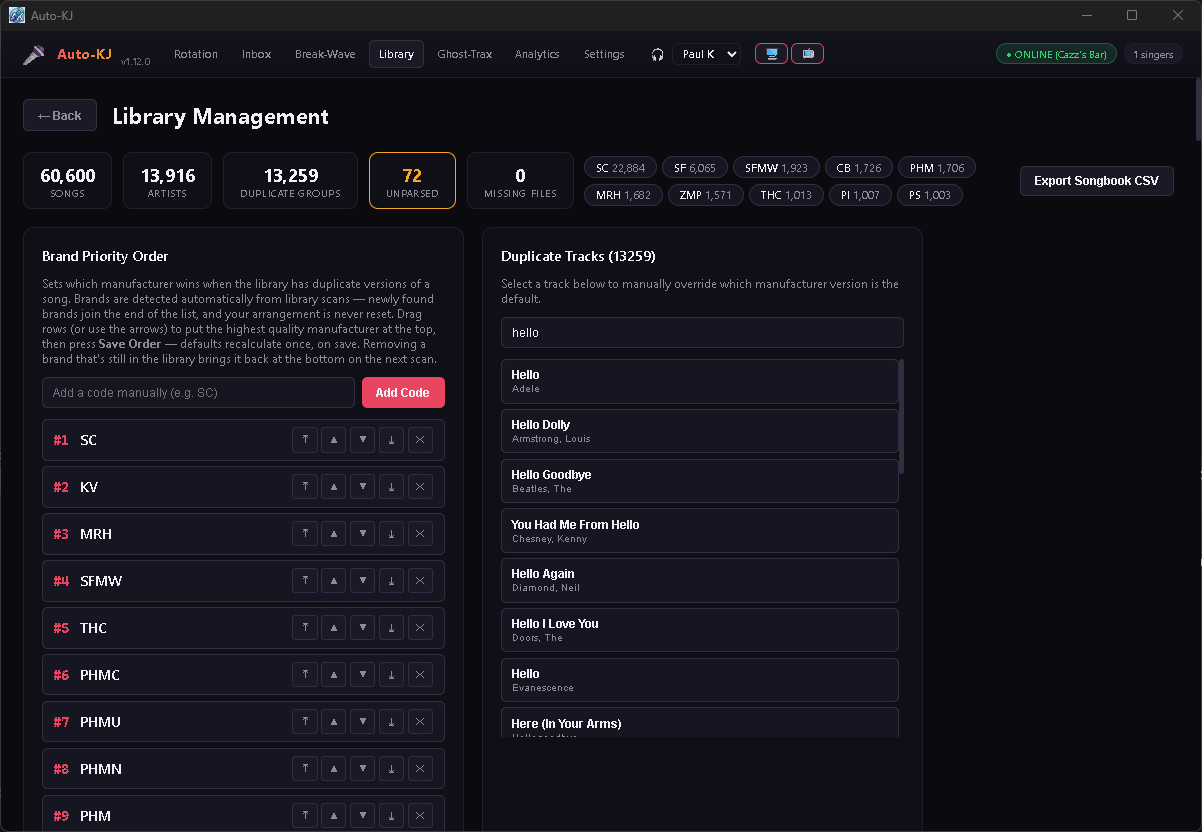
Open the tab and the first thing you see is a row of numbers: how many songs, how many artists, how many duplicate groups, how many unparsed, and how many missing files you're carrying. Then a row of brand chips — SC, DK, SF, PHM — showing exactly how your library breaks down by manufacturer.
Most KJ software hides this from you because the truth is ugly. Auto-KJ puts it front and center because the truth is fixable. Every number on that header is a lead-in to a tool that fixes it. And in the corner, one click exports your entire printable songbook as a CSV.
Brand Priority: the feature nobody else has
Here's the thing that separates Auto-KJ from every other karaoke program on Earth: it knows a song can exist in five different pressings, and it lets you tell it which one to actually play.
The Brand Priority Order card lists every manufacturer detected in your library. Drag Sound Choice above Sunfly, put Pocket Songs under DK, drop the bootleg-looking code to the bottom — then hit Save Order.
The moment you save, Auto-KJ walks your entire library and re-sets the default version of every duplicate according to your ranking. Every "My Way" now points at the pressing you actually want. It's not a one-at-a-time chore; it's a library-wide policy.
And here's the engineering part that should make you trust it: reordering is done locally, so you can drag and shuffle twenty brands without a single hiccup, and the full recalculation runs exactly once, on save. New brands found during a scan join the bottom of the list automatically, and your arrangement is never reset. No other software does this. Most of them don't even know their library has duplicate brands.
The duplicate resolver: pick your pressing per song
When Auto-KJ finds the same song across multiple manufacturers, it groups them. Click any group and you get a clean Version Options table: which pressing is the default, the brand, the disc/track number, and the actual filename.
One click on Make Default and that's the version every singer gets when they request the song. The old default doesn't disappear — it stays in the group, ready to swap back any time. You're not deleting music. You're just choosing which record the needle drops on.
Fix Unparsed Songs: repair, don't delete
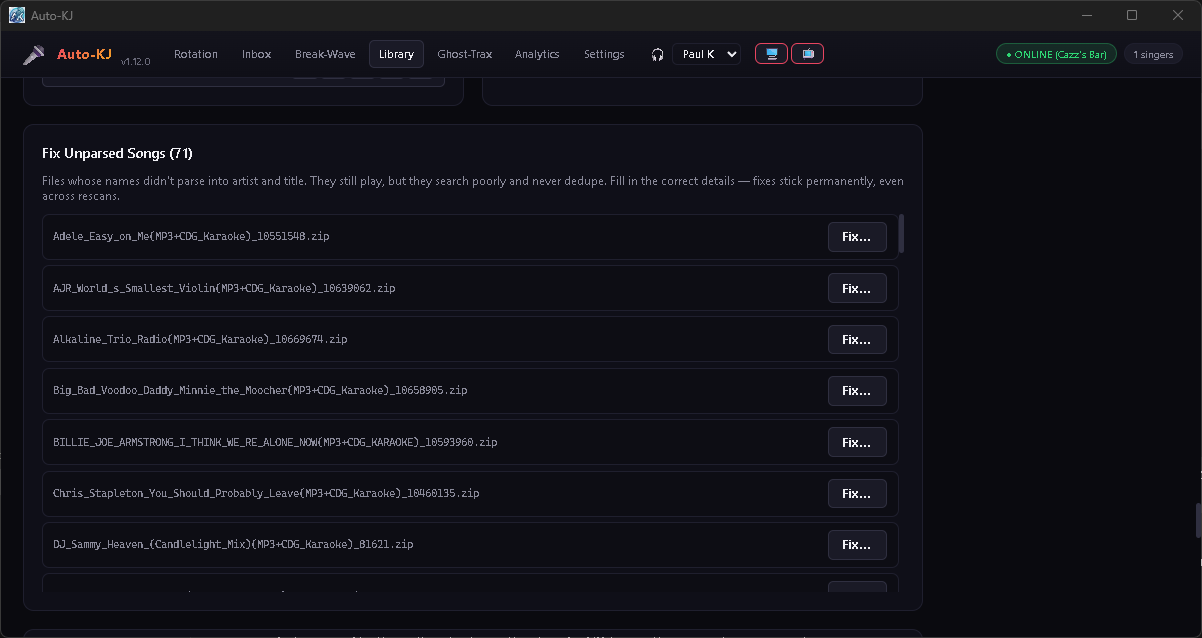
Every library has a handful of files that just refuse to parse — weird names that don't split into artist and title. They still play, but they search like garbage and never dedupe.
The Fix Unparsed Songs card lists them all. Click Fix…, type the right artist, title, and brand, check Rename file to match if you want the file itself cleaned up on disk, and save. Here's the part that matters: the fix is sticky. It survives every future rescan, because Auto-KJ flags your corrections as manual metadata and never lets a directory scan overwrite them.
The same engine powers Edit Song Details, where you can search the entire catalog, find a song that parsed wrong (swapped artist and title, wrong brand), and correct it — permanently, and optionally renaming the file so even a from-scratch scan gets it right.
The cleanup crew (that never deletes anything)
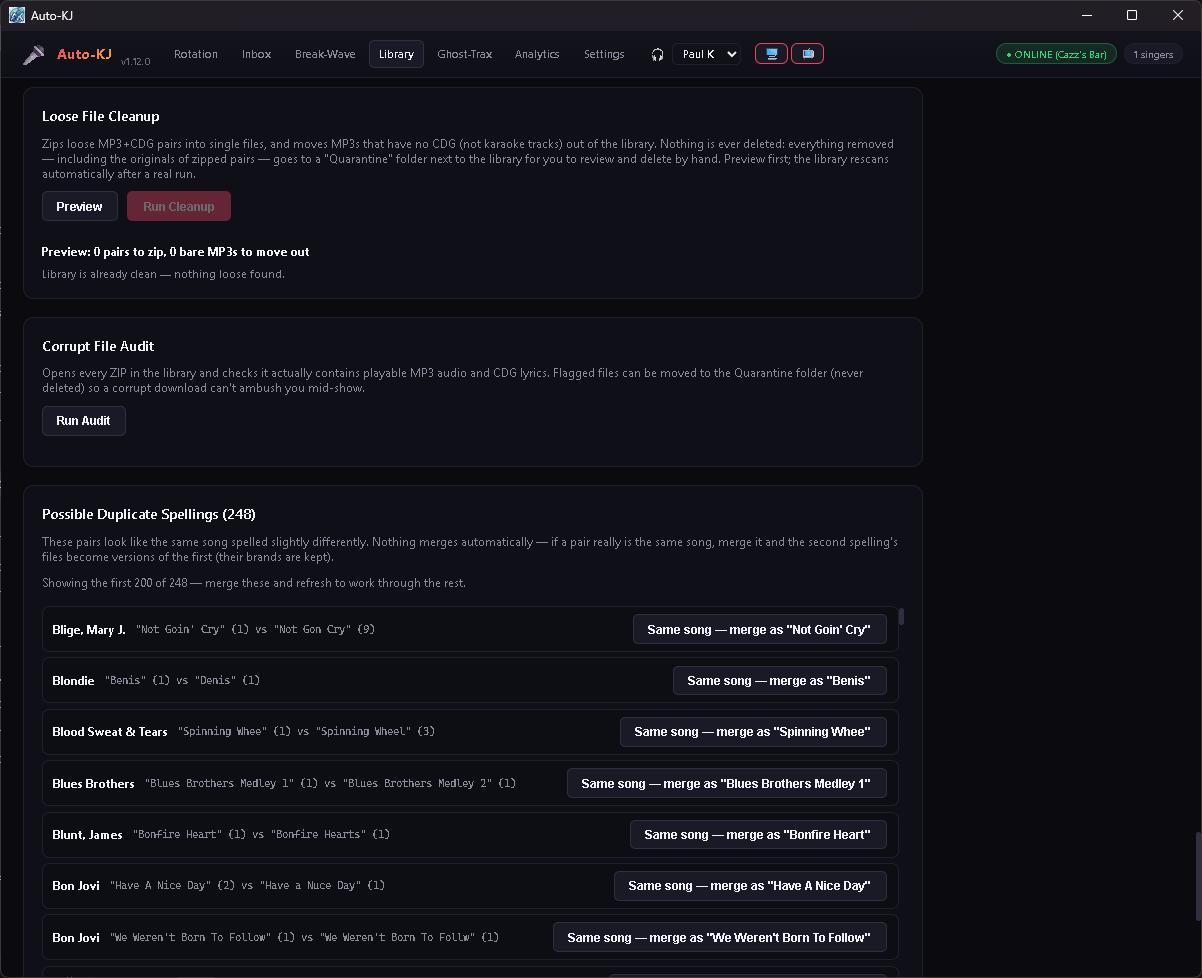
Auto-KJ never deletes a file. Not one. Ever. Everything it removes from your library is moved to a Quarantine folder next to your library, sorted by reason, so you can eyeball it and empty it by hand when you're good and ready.
What does the cleanup crew do?
Loose File Cleanup — finds stray MP3+CDG pairs sitting as two files and zips them into one; finds bare MP3s with no CDG (not karaoke tracks) and moves them out. Preview first, then run. The library rescans itself afterward.
Missing Files — catalog entries pointing at files that are gone (moved, renamed elsewhere, disconnected drive). These are the songs that'd fail the second a singer requests them. Remove the entries, never the files.
Corrupt File Audit — opens every ZIP in your library and verifies it actually contains a playable MP3 audio stream and a CDG lyrics stream. A corrupt download gets flagged before it can ambush you mid-show.
Redundant Copies — the exact same pressing sitting in three different folders. One copy is kept; the extras go to Quarantine.
Every one of these is a "review it yourself" operation, not a "trust the computer" operation. The computer does the heavy lifting; you keep final say. That's the deal.
The detective work: duplicate spellings & artist variants
Two songs that are secretly the same song but spelled differently — Love Shack and Love Shack (Radio Edit) — show up in Possible Duplicate Spellings. One click merges the second spelling into the first, keeping both files' brands, so nothing is lost and nothing double-lists.
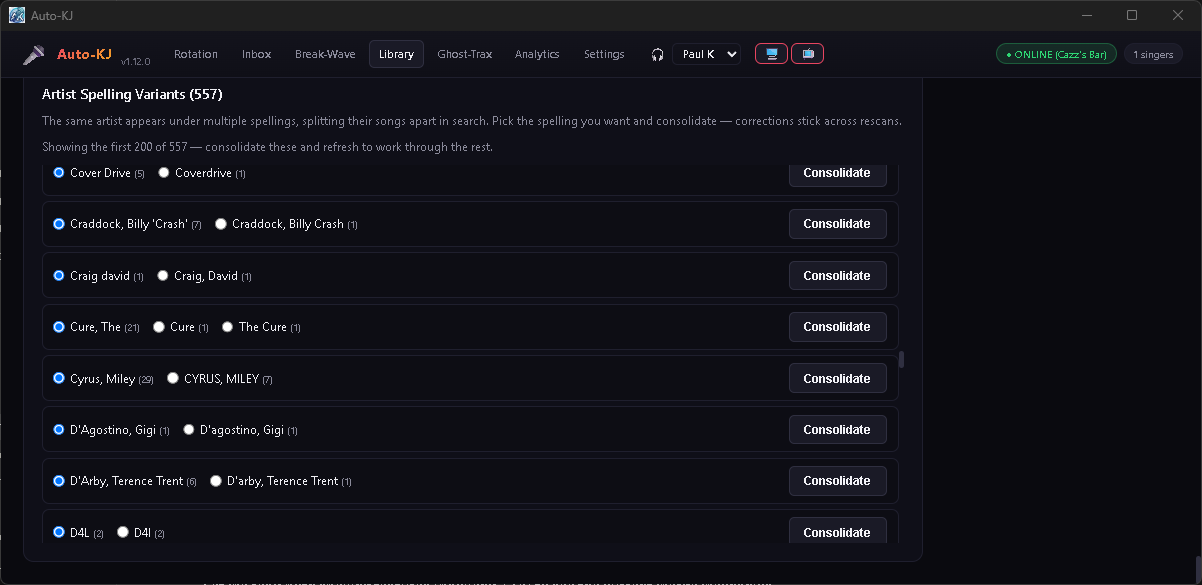
Same idea for Artist Spelling Variants: Prince vs Prince & The Revolution vs The Artist Formerly Known As Prince. Auto-KJ spots when one artist's catalog is split across spellings, you pick the spelling you want, and one Consolidate button reunites the catalog. Sticky across rescans, obviously.
Why it never freezes on a big library
This is the unglamorous part that matters when you've got 60,000 songs: every health check — stats, missing files, redundant copies, duplicate spellings, artist variants — loads in parallel, so one slow report can't blank the whole screen. Long lists render in capped pages with the totals still shown up top. And the brand recalc runs once on save, not on every drag.
A library this size would turn most software into a beach ball. Auto-KJ treats it like a Tuesday.
The one-sentence pitch
Other karaoke software treats your library as a pile of files. Auto-KJ treats it as a policy — your brand preferences, your corrections, your merge decisions — and enforces that policy every time a singer requests a song, without ever deleting a single file you didn't personally send to the trash.
GET THE FREE VERSIONMore guides: rotation rules · Fairness Engine · all guides